

 Česky (CZK)
 Deutsch (EUR)
 Polski (PLN)
 Français (EUR)
 Español (EUR)
 Italiano (EUR)
 Română (EUR)
 Ελληνικά (EUR)
 Dutch (EUR)
 Eesti keel (EUR)
 Português (EUR)
 Magyar (EUR)
 Svenska (EUR)
 Dansk (EUR)
 Suomen kieli (EUR)
 български език (EUR)
 Slovenščina (EUR)
 Slovensky (EUR)
 lietuvių kalba (EUR)
 latviešu valoda (EUR)
 Hrvatski (EUR)
 українська мова (EUR)
 Bahasa Indonesia (EUR)
How to choose the right collagen? An overview of types, effects and dosage
- What is collagen and why does the body need it
- Not all collagen is the same
- Is it worth taking collagen supplements?
- The benefits of collagen
- Who is collagen ideal for?
- Which collagen is best?
- How to take collagen supplements
- Choose the highest-quality collagen supplements
- Is it worth taking collagen supplements?
- FAQ
What is collagen and why does the body need it
Collagen is a structural protein – that is, a protein that gives tissues strength and elasticity.
Collagen makes up approximately:
- 75% of the skin’s structure
- 30% of all proteins in the body
- a large proportion of joint cartilage, tendons and ligaments 🦴
Without collagen, our body simply wouldn’t hold itself together.
Not all collagen is the same
There are many types of collagen, each with different functions in the body. The main types include:
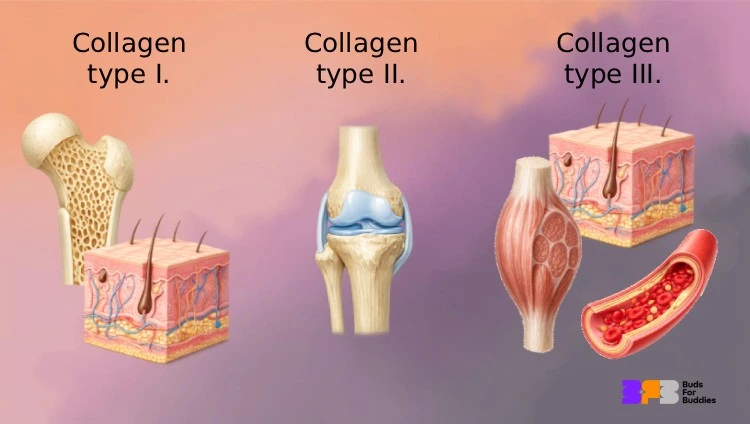
- 💪 Type I collagen: Up to 90% of all collagen in the human body, found in the skin, bones, tendons and ligaments, ensuring they remain strong.
- 🦴 Type II collagen: Essential for joint cartilage, it protects the joints and improves their mobility.
- 🫀 Type III collagen: Found in the skin, blood vessels and muscle tissue, it contributes to their elasticity and regeneration.
Is it worth taking collagen supplements?
The body begins to produce less collagen around the age of 25. The amount then gradually decreases each year.
This can lead to:
- the formation of wrinkles,
- loss of skin elasticity,
- weak hair and nails,
- slower skin and joint regeneration,
especially if you are also under stress, smoke, have a poor diet and don’t get enough sleep.
That is why it is advisable to support collagen production from a young age. Can collagen supplements help with this?
What the science says
A 2014 study examined the effects of hydrolysed collagen on skin quality in 69 women aged 35–55 over an 8-week period. The participants took 2.5 g of collagen, 5 g of collagen, or a placebo daily. The results showed that the women taking collagen experienced a significant improvement, and this effect persisted for up to 4 weeks after stopping the supplement, particularly among older participants. No side effects were reported.
The positive effect of collagen supplementation on joint health is suggested, for example, by research from 2008. 97 participants were divided into two groups; one took 10 g of hydrolysed collagen for 24 weeks, whilst the other took a placebo. The results showed that those taking collagen experienced a significant reduction in joint pain during various activities, particularly among those suffering from knee pain.
Research to date therefore supports the benefits of supplementation.
Benefits of collagen
Adequate collagen intake can support a number of key processes in the body.
The main benefits of collagen include:
- ✨ Supporting skin health: Collagen helps maintain the skin’s firmness and elasticity. As a result, it can help slow the appearance of wrinkles and contribute to an overall healthier complexion.
- 💅 Hair and nail support: Sufficient collagen can contribute to stronger nails and hair.
- 🦵 Joint and cartilage health: Collagen is a fundamental building block of joint cartilage. Sufficient levels can support joint mobility and alleviate discomfort during movement.
- 🦴 Bone support: Collagen forms a significant part of bone structure and contributes to bone strength. It is particularly important for bones as we age or for women after the menopause.
- 🩹 Tissue regeneration and healing: Collagen plays a key role in tissue repair, whether it be skin, muscles or ligaments. It supports faster recovery after exercise or minor injuries.
Who is collagen ideal for?
Collagen is a suitable supplement for anyone who:
- 💅 wants to improve the quality of their skin, hair and nails
- 🏃 exercises or engages in other physical activity
- 🧘 wants to boost their body’s overall vitality

Collagen for women
For women, collagen is often associated primarily with its aesthetic effects on the skin, hair and nails. However, its importance for the female body is much broader.
Adequate collagen intake can be particularly important during the menopause. This is because, at this stage of life, there is a decline in oestrogen levels – a hormone that plays a significant role in maintaining collagen in the tissues and preserving healthy bone structure.
A 2018 study followed 131 postmenopausal women with reduced bone density who took 5 g of collagen peptides or a placebo daily for 12 months. Of the 102 women who completed the study, the results showed a significant improvement in bone density in the spine and hip in those taking collagen compared to the placebo group.
Which collagen is best?
There is a wide range of collagen supplements on the market, but which is the best? It all depends on your preferences.
Before you start choosing a suitable supplement, you should know what the aim of supplementation is. If it is primarily to support skin elasticity, choose supplements containing type I collagen; if it is to support joints, choose those containing type II.
Next, consider which form you prefer. Whilst collagen powder is popular for its versatility, with capsules you don’t have to worry about measuring out the dose, and they’re handy for travelling.
Types of collagen by origin
| Type | Characteristics | |
|---|---|---|
| 🐟 Marine collagen | I | suitable for promoting skin elasticity |
| 🐔 Chicken collagen | II | suitable for supporting joint health |
| 🐄 Bovine collagen | I or III | similar structure to human collagen, supports skin elasticity and tissue regeneration |
| 🐷 Pork collagen | I or III | similar structure to human collagen, supports skin elasticity and tissue regeneration |
Hydrolysed vs. native collagen
The most common form of collagen in dietary supplements is hydrolysed collagen, also known as collagen peptides.
Hydrolysis is a process in which large collagen molecules are broken down into smaller parts – peptides. This allows the collagen to be easily absorbed in the intestines, and the body can effectively use it as a building block for producing its own collagen.
Native collagen, on the other hand, retains its original molecular structure. It does not serve as a source of building blocks, but has an immunological effect. A small amount of native type II collagen can activate a process in the gut known as oral tolerance, which may help:
- reduce the inflammatory response in the joints
- protect joint cartilage
- relieve joint pain.
Another type of collagen is gelatine, which is partially broken-down collagen produced when collagenous tissues are heated.
Forms of collagen supplements
| Form | Main benefits |
|---|---|
| Collagen powder |
|
| Collagen capsules and tablets |
|
| Liquid collagen, collagen drinks |
|
| Collagen mask |
|
Collagen can also be obtained naturally from food. Bone broth or chicken skin and cartilage, for example, are rich in collagen 🍗.
As well as collagen itself, it is also important to consume nutrients that support the body’s natural production of collagen, such as vitamin C, protein, zinc and copper 🍊.

How to take collagen supplements 💊
For collagen supplementation to be truly effective, it’s not enough to simply add it to your diet occasionally — consistency is key. You should take collagen regularly and over the long term. Most scientific studies monitor the effects of collagen supplements over a period of 8 to 12 weeks, when the first visible results begin to appear.
How much collagen per day 📆
The optimal amount of collagen depends on the type of collagen, the specific product, your goals and your body weight.
For hydrolysed collagen, the recommended daily dose is usually:
- 2.5–5 g per day to support skin health
- 5–10 g per day to support joints, muscles and recovery
Native collagen is taken in significantly lower doses, usually between 20–40 mg per day.
When and how to take collagen ⏰
Collagen can be taken at any time of day. Some people prefer to take it in the morning, for example in a smoothie, whilst others prefer to take it before bed. The exact time isn’t crucial; what matters is consistency and long-term use. So choose a product that you can easily incorporate into your routine.
Don’t forget to include vitamin C in your diet, as it plays a vital role in the body’s production of collagen. Many collagen products contain it. Alternatively, vitamin C can be taken as a dietary supplement or obtained from fruit and vegetables, such as citrus fruits 🍋.
Choose the highest-quality collagen supplements
Our range includes collagen supplements from manufacturers Cannor and Hemnia.
In addition to collagen, these also contain:
- hyaluronic acid, which supports skin regeneration
- acerola, rich in vitamin C
- inulin, a natural fibre from chicory
One pack contains 30 sachets, which is a month’s supply. Choose from the following flavours:

Is it worth taking collagen supplements?
Collagen is a fundamental structural protein in the human body and plays an important role in the health of the skin, joints, bones and other connective tissues. As its natural production gradually declines from a young age, supplementing it can be a suitable way to support the body’s regeneration, skin health and musculoskeletal system in the long term.
When choosing a collagen supplement, it is important to consider the type of collagen, the form of the supplement and its composition. Hydrolysed collagen is the most common choice due to its excellent absorption, whilst native collagen is used specifically to support joint health.
Taking collagen is suitable for anyone, particularly for athletes and women going through the menopause.
FAQ
1. Can collagen be replenished naturally?
Yes. Foods with a higher collagen content include, for example, bone broths, meat with skin, and cartilage. A varied diet is essential; the body’s natural production of collagen is supported by vitamin C, protein, zinc and copper.
2. How long does it take for collagen to start working?
Most studies show the first visible changes after 8 to 12 weeks of regular use. Long-term and regular consumption is particularly important.
3. How long can collagen be taken safely?
As it is a natural protein that is a common component of the human body, long-term supplementation is generally considered safe.
4. Does collagen have any side effects?
Collagen is generally considered a safe dietary supplement; no serious side effects have been reported. However, when choosing collagen, pay attention to its source — for example, if you have a fish allergy, avoid marine collagen.
5. Should I take collagen even if I don’t suffer from joint pain?
Yes! Collagen isn’t just important for your joints; it also plays a vital role in maintaining healthy skin, hair, nails and other connective tissues. Collagen production starts to decline after the age of 25.
6. What is the best collagen for women?
Type I collagen, which is the main component of the skin, is most commonly recommended for skin support. If the aim is to support bones and joints, particularly during the menopause, type II collagen may be more suitable.
Hydrolysed collagen is considered to be an easily absorbed form.
7. Is there such a thing as vegan collagen?
Collagen itself is a protein found naturally only in animal tissues. Products labelled as vegan collagen contain substances that support the body’s natural production of collagen, usually amino acids and vitamin C in particular.
Sources:
- https://pubmed.ncbi.nlm.nih.gov/23949208/
- https://pubmed.ncbi.nlm.nih.gov/18416885/
- https://pubmed.ncbi.nlm.nih.gov/29337906/
Author: Natálie Kubíčková
Photo: AI
"All information provided on this website, as well as the information provided through this website, is for educational purposes only. None of the information contained herein is intended as a substitute for medical diagnosis and such information is not to be considered medical advice or recommended treatment. This website does not promote, endorse or advocate the legal or illegal use of narcotic drugs or psychotropic substances or the commission of any other illegal activity. Please see our Disclaimer for further information."