
 Česky (CZK)
 Deutsch (EUR)
 Polski (PLN)
 Français (EUR)
 Español (EUR)
 Italiano (EUR)
 Română (EUR)
 Ελληνικά (EUR)
 Dutch (EUR)
 Eesti keel (EUR)
 Português (EUR)
 Magyar (EUR)
 Svenska (EUR)
 Dansk (EUR)
 Suomen kieli (EUR)
 български език (EUR)
 Slovenščina (EUR)
 Slovensky (EUR)
 lietuvių kalba (EUR)
 latviešu valoda (EUR)
 Hrvatski (EUR)
 українська мова (EUR)
 Bahasa Indonesia (EUR)
The Pacific symbol of relaxation — discover Kava Kava!
- What is Kava Kava?
- How does Kava Kava work?
- What forms does Kava Kava come in?
- Kava kava: an unexplored path to well-being
- FAQ
What is Kava Kava?
Kava Kava, Latin name Piper methysticum, is a tropical shrub with heart-shaped green leaves that grows up to 6 metres tall. The plant is also known as intoxicating pepper and grows on the Pacific Islands 🏝️.
Its most precious part is hidden beneath the surface — it is the root of this shrub that has become famous for its unique effects. It is said to relieve pain and calm not only the body but also the mind, inducing euphoria.
While Pacific Islanders have been using this gift of nature in traditional medicine and religious rituals for centuries, Europeans only discovered it much later — the intoxicating pepper tree was brought to the continent by navigator James Cook in the 18th century🌍 . We owe its first description to the Forest father and son.
However, it is only today, thanks to greater availability and the growing popularity of alternative natural medicine, that Kava Kava is attracting public interest and beginning to be studied more closely.

How does Kava Kava work?
The root of the plant is rich in psychoactive kavalactones. They make up to 20% of the root's weight and probably affect:
- GABA receptors: These receptors inhibit the activity of the nervous system, leading to reduced tension, calmness and relaxation.
- Serotonergic and dopaminergic systems: Higher levels of serotonin and dopamine are responsible for improved mood.
By acting on these systems, Kava Kava could relieve pain, alleviate anxiety and stress, and induce a good mood or even euphoria 😌. It could also contribute to better sleep 💤.
These potential effects are also supported by new studies.
Testing showed that almost three-quarters of the test subjects experienced a significant reduction in anxiety. They were given 300 mg of extract daily for several weeks, with a noticeable reduction in anxiety after just one week and progressive improvement thereafter.
Another study, conducted on 75 participants diagnosed with generalised anxiety disorder, found that at the end of the study, 26% of extract users were classified as cured. The study also showed that Kava Kava is generally well tolerated and is not addictive.
The positive effect on stress reduction and sleep improvement was confirmed by the results of a subjective assessment of 24 people who took 120 mg of the extract daily for 6 weeks as part of the study.
Possible side effects
Like any other substance, Kava Kava has side effects. These include:
- drowsiness
- nausea
- dizziness
- vivid dreams
Kava Kava should not be used long-term as it can damage the liver, which manifests itself in dry and yellowish skin, among other things. It can also increase hand tremors.
🚫 It should not be consumed by pregnant or breastfeeding women and should never be combined with medication, alcohol or drugs. Caution should also be exercised when using nicotine or caffeine.
What forms does Kava Kava come in?
In indigenous cultures, the root is traditionally crushed and mixed with coconut milk or water and served as a drink.
As for Kava Kava products, it is sold on the market as:
- powder from dried and ground root
- capsules or tablets with extract with standardised kavalactone content
- tincture
- liquids for vapes
Due to insufficient research and unclear legislation, Kava Kava products are not commonly sold as products intended for consumption, but as collectibles.
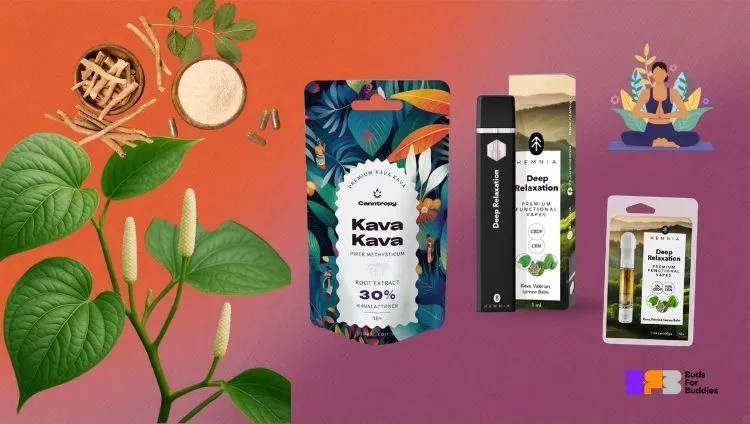
Kava kava: an unexplored path to well-being
Kava Kava is a plant from the Pacific. Its root is particularly prized. It contains psychoactive kavalactones, which may affect pain, reduce anxiety and stress, induce good mood or even euphoria, and improve sleep.
Initial research supports these effects and shows that Kava Kava is generally well tolerated and non-addictive. However, it can cause drowsiness, nausea, dizziness or vivid dreams. Long-term use can cause liver damage.
Kava Kava is most commonly found in the form of powder from dried and ground roots or as an extract. Kava Kava capsules and tablets, tinctures, and even liquids for vapes are also sold.
Although this root has promising therapeutic potential, it should be noted that there are not yet enough studies, so Kava Kava cannot be approved as a safe product for consumption. If you decide to learn more about it, you should exercise caution.
FAQ
1. Is Kava Kava legal ⚖️?
In most countries, Kava Kava is available and not subject to regulation. However, legislation can change quickly, so it is important to always check the current legal status in the specific country where you are located.
2. Is Kava Kava a drug 💉?
Legally, Kava Kava is not usually classified as a drug. However, it contains psychoactive kavalactones, which means that it affects the nervous system and can alter mood and perception. Unlike other psychoactive substances, Kava Kava should not cause hallucinations or addiction.
3. How long does Kava Kava last ⏱️?
The effects appear 10-45 minutes after consumption, with euphoria lasting up to 3 hours and a feeling of relaxation lasting up to 36 hours.
4. Will Kava Kava show up on a drug test?
Standard drug tests cannot identify kavalactones, and Kava Kava should not show up on them.
5. Can Kava Kava replace anxiety medication 💊?
No. Although research suggests that Kava Kava has relaxing effects, it definitely cannot replace treatment recommended by a doctor.
Sources:
- https://www.rmg.co.uk/collections/objects/rmgc-object-154082
- https://researchoutreach.org/articles/de-mythologizing-traditional-drink-kava/
- https://restorativemedicine.org/library/monographs/kava-kava/
- https://altmedrev.com/wp-content/uploads/2019/02/v3-6-458.pd
- https://www.verywellhealth.com/kava-uses-risks-and-more-7481255
- https://pubmed.ncbi.nlm.nih.gov/23635869/
Author: Natálie Kubíčková
Photo: AI
“All information provided on this website, as well as the information provided through this website, is for educational purposes only. None of the information contained herein is intended as a substitute for medical diagnosis and such information is not to be considered medical advice or recommended treatment. This website does not promote, endorse or advocate the legal or illegal use of narcotic drugs or psychotropic substances or the commission of any other illegal activity. Please see our Disclaimer for further information.”
Recommended products4
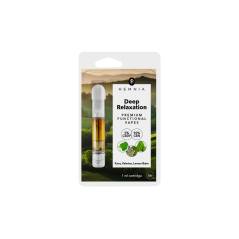
Hemnia Deep Relaxation - Cartridge, 5 % CBDP, 90 % CBN, kava kava, valerian, lemon balm, 1 ml
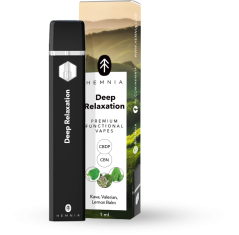
Hemnia Premium Functional CBDP and CBN Vape Pen Deep Relaxation - 5 % CBDP, 90 % CBN, Kava, Valerian, Lemon Balm, 1ml
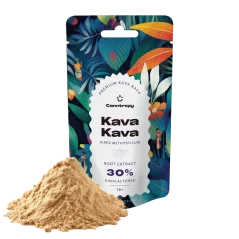
Canntropy Kava Kava (Piper methysticum) Root Extract 30% Kavalactones, 5g - 100g