

 Česky (CZK)
 Deutsch (EUR)
 Polski (PLN)
 Français (EUR)
 Español (EUR)
 Italiano (EUR)
 Română (EUR)
 Ελληνικά (EUR)
 Dutch (EUR)
 Eesti keel (EUR)
 Português (EUR)
 Magyar (EUR)
 Svenska (EUR)
 Dansk (EUR)
 Suomen kieli (EUR)
 български език (EUR)
 Slovenščina (EUR)
 Slovensky (EUR)
 lietuvių kalba (EUR)
 latviešu valoda (EUR)
 Hrvatski (EUR)
 українська мова (EUR)
 Bahasa Indonesia (EUR)
Indoor cannabis cultivation
- Lighting regime for cannabis plants
- Lighting for indoor cultivation 💡
- Growing medium and substrate for indoor cultivation
- Ventilation, temperature and humidity
- Plant growth stages
- Conclusion
- FAQ
Lighting regime for cannabis plants
Growers know that the lighting regime plays a key role in indoor cultivation, especially for photoperiodic varieties, which respond to the length of the day ☀️. These varieties begin to flower when the day shortens to approximately 12 hours of light and 12 hours of darkness.
During vegetative growth, a 18/6 regime (18 hours of light, 6 hours of darkness) is used. Once the plant has grown to the desired size, it is switched to 12/12 to start flowering. The darkness must be complete, as even a short interruption of light can cause stress to the plant, slow down flowering or produce male flowers.
Self-flowering varieties do not respond to day length and flower automatically. Growers therefore often grow them under 18/6 or 20/4 lighting throughout to promote rapid growth, as these varieties have a shorter life cycle.
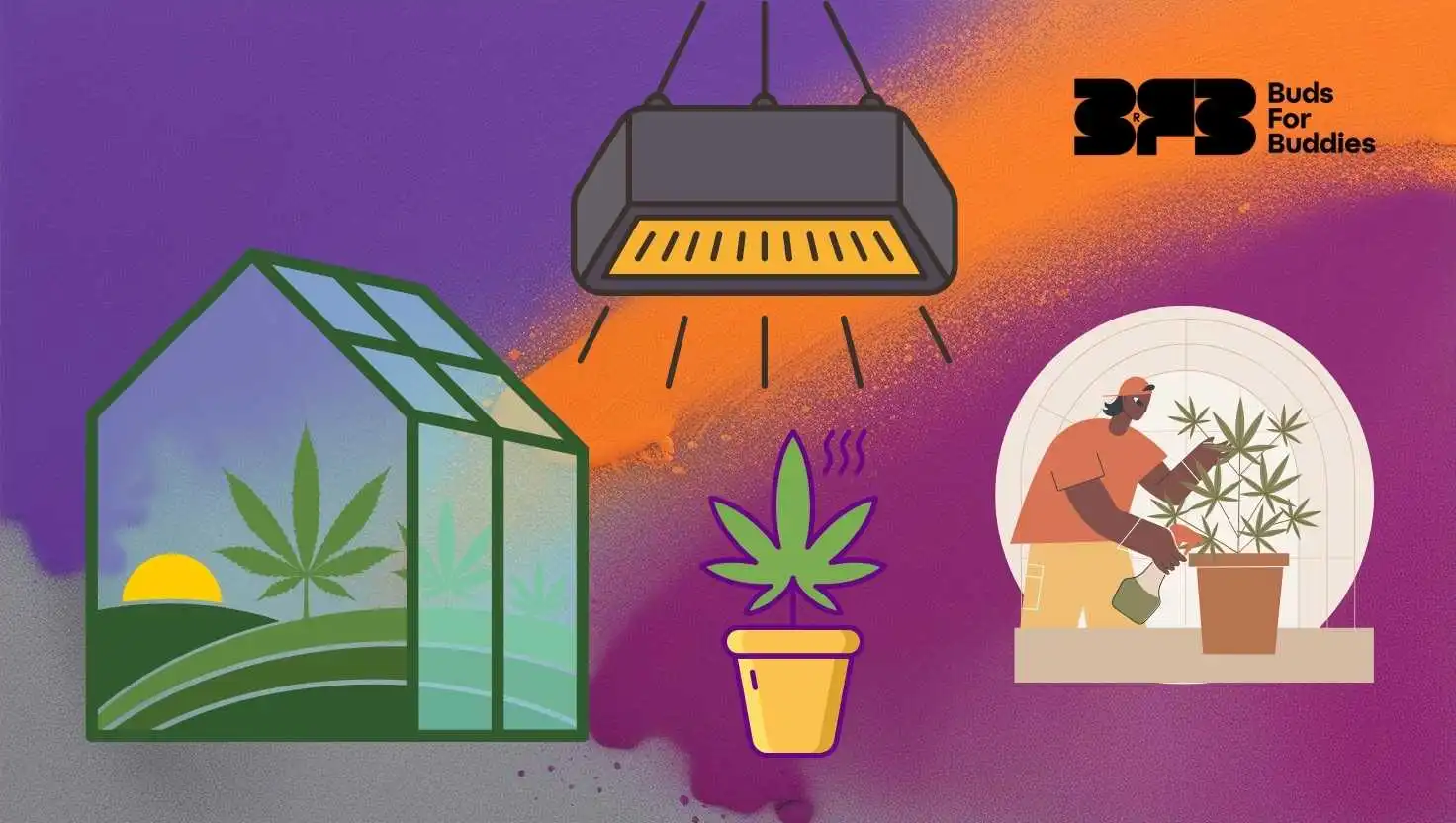
Lighting for indoor growing 💡
Growers know very well that without quality lighting, it's impossible – light is essential for growth and flowering 💡. There are several types of lighting on the market today, each with its own advantages, disadvantages and specific uses depending on the growth stage, space and budget of the grower. Let's take a look at the most commonly used ones:
- HID lamps (HPS/MH): traditional sodium and metal halide lamps with high intensity. HPS (High Pressure Sodium) is mainly used for bloom, MH (Metal Halide) for growth. They have the advantage of strong light and high yields, but they have high consumption and generate a lot of heat. Growers report that a strong exhaust fan is required because of the heat. They also hang the lights high enough above the plants to avoid burning them (a rule of thumb: approximately 400 W of HID lighting for every 1 m² of growing area).
- LED lighting: modern LED panels are popular among growers due to their lower energy consumption and lower heat emission. Growers report that 200-400 W LED panels are typically hung 30-70 cm above the plants, while the more powerful 450-600 W systems are hung 50-80 cm above the plants. Although the LEDs do not heat as much, the light can be deceptively strong, so growers monitor the plants' reactions and adjust the height of the lamp as needed.
- Fluorescent lamps (CFL/T5): energy-saving fluorescent tubes or bulbs that growers choose for small nurseries, pre-growing seedlings or cuttings. They produce only a small amount of heat and can be placed close to the plants. Nowadays, they are often replaced by LED technology.
Growing medium and substrate for indoor cultivation
The growing medium affects root growth, nutrition and the overall vitality of the plants 🌿.
Beginner growers often choose a classic soil substrate, i.e. high-quality gardening soil or a specialised mixture designed specifically for cannabis. Soil-free mixtures are suitable for indoor cultivation, as they are light, airy and retain moisture well.
Such substrates usually contain basic nutrients and promote healthy plant growth in the early stages. The substrate, known as light mix, is lightly pre-fertilised, airy and mixed with perlite or coconut fibres, which improve drainage and aeration of the roots.
Proven soil composition:
- Ratio 7:3 (peat and perlite in a ratio of 7:3, with a small amount of coconut) or ratio 1:1:1 (peat or coconut fibre + perlite + compost)
- Peat / coconut fibre – excellent water retention
- Perlite – ensures aeration and drains excess water
- Compost – provides nutrients and humus for growth
Growers who want full control over plant nutrition usually choose coconut fibre. It is a soilless, light and airy medium (hydroponic type) that oxygenates the roots and promotes rapid growth. And because coconut fibre does not contain any nutrients, all nutrition is supplied with each watering (usually in the form of a weak fertiliser solution). The advantage for growers is precise dosing and good water retention (if the container has a drain).
Growing in coconut fibre requires regular fertilisation and monitoring of the pH level between 5.5 and 6.5, but it is very popular indoors (thanks to the balance between air, water and control).
To prevent the roots from becoming waterlogged, pots with sufficient drainage holes are recommended, with the size of the pot chosen according to the planned size of the plant (most often pots with a volume of 10–20 litres).
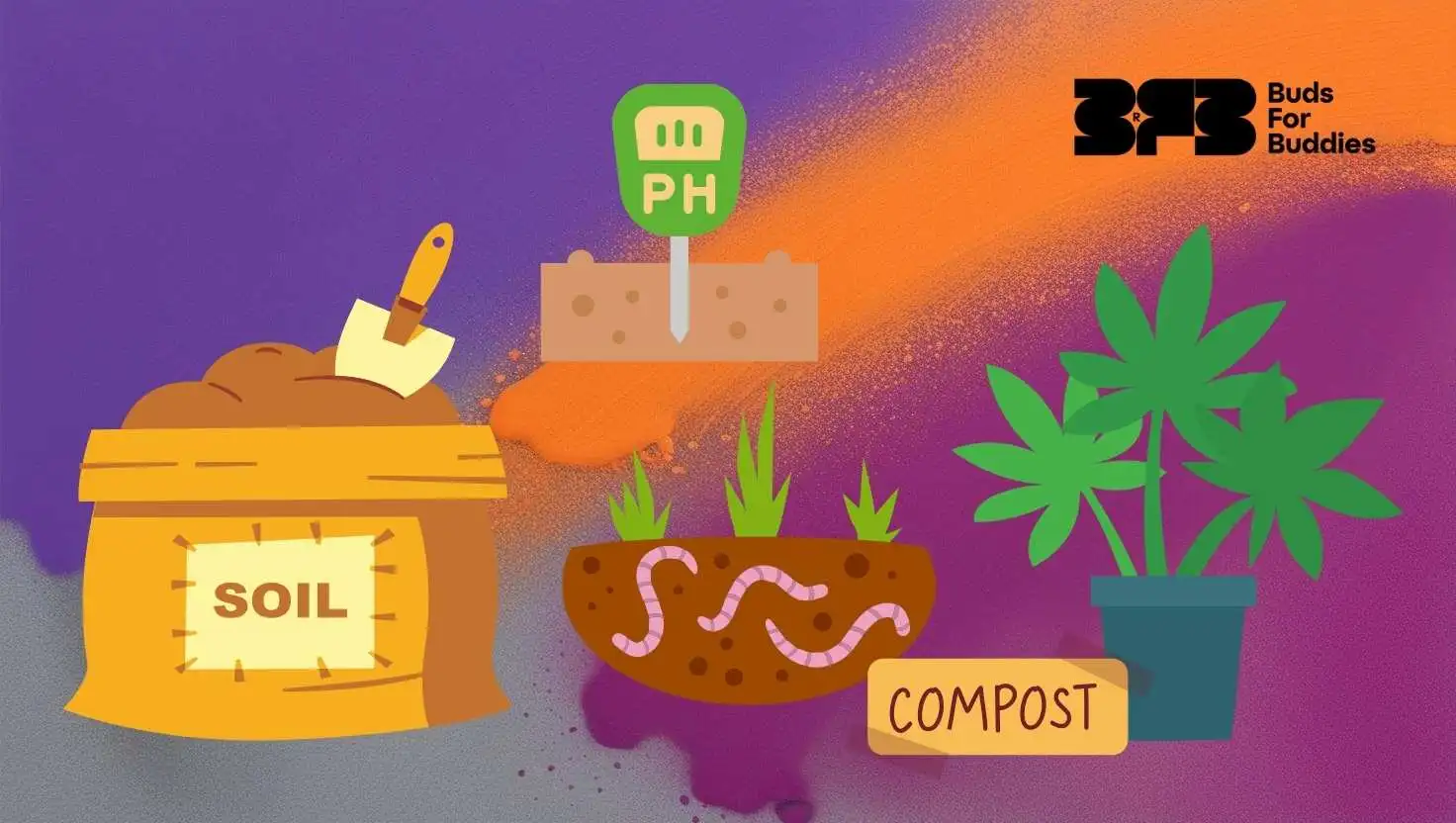
Experienced growers choose an advanced method called hydroponics (soilless cultivation). The roots are placed in an inert medium (e.g. expanded clay, rockwool) or directly in a water solution that is constantly oxygenated and circulated.
This is a technically and financially more demanding option that requires constant monitoring of pH, conductivity and overall system functionality. Hydroponic systems such as DWC, NFT or aeroponics allow growers to achieve extremely fast plant growth and high yields.
Ventilation, temperature and humidity
In an enclosed space, plants need fresh air and a stable climate. Without this, growers risk not only the occurrence of mould and pests, but also slowed plant growth.
Ventilation and air flow:
- Exhaust fan – removes warm and stale air, ideally with a carbon filter (to remove odours).
- Circulation fan – circulates air between plants, strengthens stems (imitates wind).
Growers say that the space must be well ventilated – warm and stale air must be constantly replaced with fresh air. If the air stagnates and remains humid, the risk of mould, pests and other diseases increases significantly. Humidifiers (for excessively dry air) and dehumidifiers (for excessively humid air) are used to control humidity.
Temperature 🌡️:
- During the day: 24–26 °C
- At night: 18–20 °C
- Day/night difference max. 8–10 °C
- Depending on the stage:
- Seedlings: 20–25 °C
- Vegetative stage 22–28 °C
- Flowering: 20–26 °C
Cannabis thrives best at 20–28 °C depending on the stage of growth. In general, it can tolerate slightly higher temperatures during growth, but prefers a slightly cooler climate during flowering.
Air humidity 💧:
- Seedlings: 60–70%
- Growth: 50–60%, less for larger plants
- Flowering: 40–50%
Growers point out that excessive humidity above 70% in poorly ventilated areas often leads to mould (especially in dense flowers, where there is a risk of grey mould called botrytis). Conversely, low humidity below 30% can cause leaves to dry out and young seedlings to grow poorly.
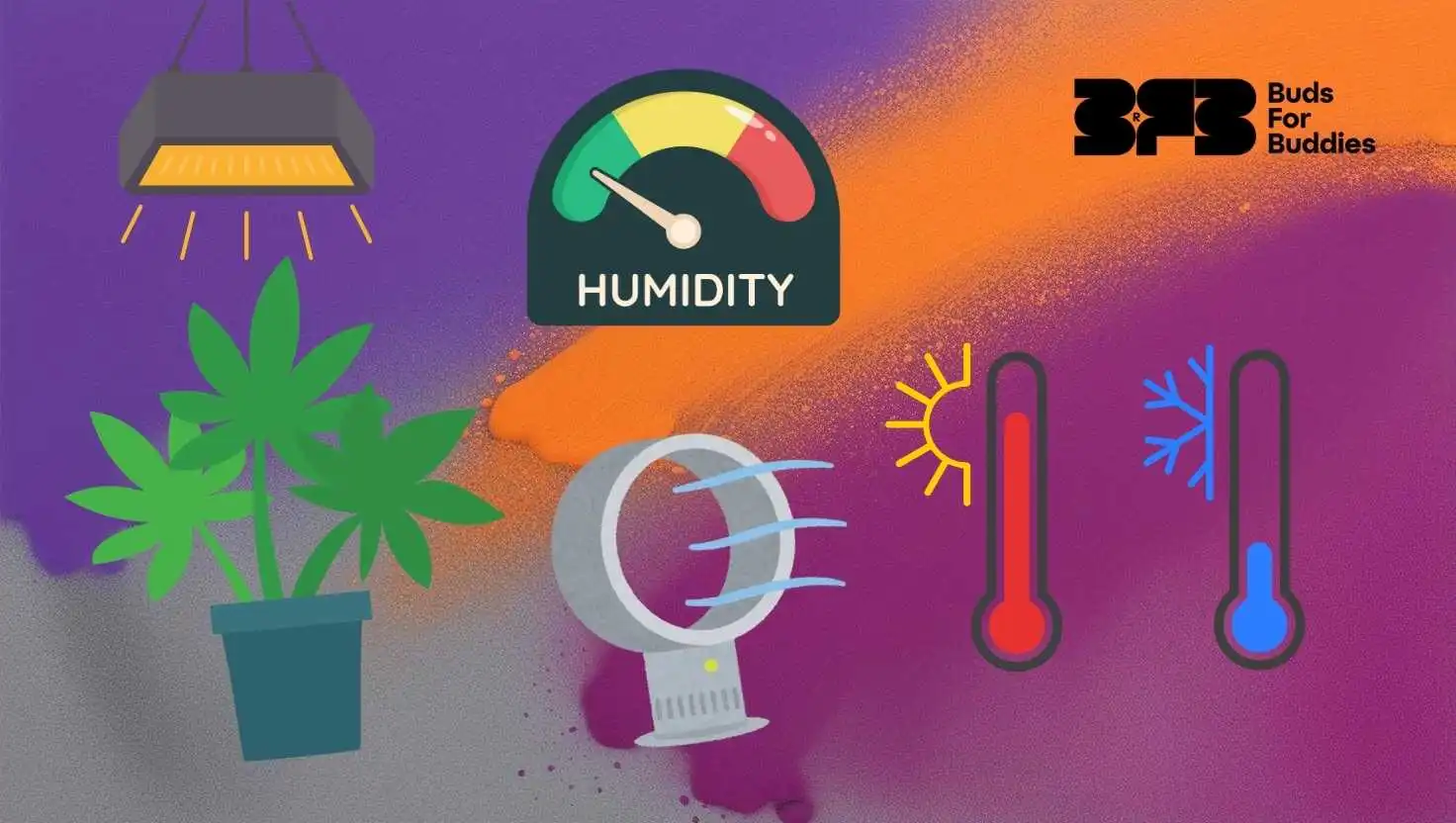
Plant growth stages
Indoor cannabis cultivation from seed to harvest takes approximately 3–5 months depending on the variety and conditions. Below is an overview of the individual growth stages from seedling to flowering.
1. Seedlings and transplanting 🌱
Seedlings are small plants with their first true leaves. This early stage of development lasts approximately 2–3 weeks after germination.
- Lighting: 18+ hours of light per day.
- Temperature 20–25 °C, humidity 60–70%.
- Small plants do not need much water – the substrate should be moist but not waterlogged.
- Time for transplanting: As soon as the roots fill the small pot.
2. Vegetative growth (growth phase) 🌿
In this phase, cannabis plants grow in height and width, but do not yet flower. This usually lasts 4–8 weeks, depending on the variety and the grower's intentions. For photoperiodic plants, the length of growth is determined by the grower (before switching to flowering), while for autoflowering plants, growth is shorter and transitions smoothly into flowering around 3–4 weeks of age.
- Lighting: Standard 18 hours of light / 6 hours of darkness per day.
- Temperature around 22–28 °C, humidity 40–60%.
- In this phase, the plants drink a lot, but in addition to water, the roots also need plenty of air.
- Cannabis requires a lot of nitrogen and slightly less phosphorus and potassium, fertiliser labelled as ‘Grow’.
- Growers often prune and bend the plants during the vegetative phase to encourage branching and keep them low.
3. Flowering (generative phase) 🌸
Different varieties flower for different lengths of time – the average is around 8 weeks of flowering.
- Lighting regime: 12/12.
- Temperature 20–26 °C during the day, around 18–20 °C at night, humidity 40–50% (growers reduce humidity to 30% towards the end to promote resin formation).
- The plants drink a lot of water.
- Cannabis needs nutrients with a higher content of phosphorus and potassium and a lower content of nitrogen for flower and resin formation, a fertiliser labelled ‘Bloom’.
Growers can tell when the plant is ready by the browning of the pistils on the flowers and especially by the trichomes (resin glands) – the ideal time to harvest is when most of the trichomes are milky white and some are already amber.
Conclusion
Indoor cannabis cultivation gives growers full control over conditions, but also requires attention at every stage. The right light, suitable substrate, stable climate and regular care are essential for healthy plant growth.
FAQ
1. What types of seeds are available for indoor cultivation?
Growers can choose from several types of seeds:
- Feminised: produce only female plants.
- Autoflowering: start flowering automatically after 2–4 weeks of growth, regardless of the length of light exposure.
- Fast flowering: reach the flowering and ripening stage within a short period of time.
- CBD-rich seeds: contain a high percentage of cannabidiol (CBD) and minimal amounts of THC (available in feminised, regular, fast flowering and autoflowering varieties).
- Certified technical varieties: certified cultivars of cannabis sativa (technical) with minimal THC content; seeds of these varieties are usually regular (mixed gender).
2. What method can growers use to germinate seeds?
Growers recommend starting with a selection of healthy seeds – ideally dark and firmly streaked. Light-coloured and empty seeds often do not germinate.
Seeds can germinate in two ways:
- Paper towel method – seeds are left to germinate between damp paper towels in a warm, dark place.
- Direct sowing – the seeds are sown directly into a moist substrate, where they germinate naturally.
3. What is the optimal light cycle for indoor cultivation?
Growers adhere to the following light regimes:
- Vegetative phase: 18 hours of light / 6 hours of darkness per day.
- Flowering (for photoperiodic varieties): 12 hours of light / 12 hours of darkness per day.
- Autoflowering varieties: Usually 18–20 hours of light per day throughout the growing period.
4. What do growers do when it's time to harvest?
Growers proceed in three steps:
Harvest
- Cut the plants whole or in parts
- Remove large fan leaves
- Trim the ‘sugar’ leaves immediately (wet trim) or after drying (dry trim)
Drying
- The branches are hung in a dark place with air circulation
- Temperature: 18–20°C, humidity 50–55%
- Drying takes 7–14 days (the twigs should break when bent)
Curing
- The buds are placed in jars or sealed containers and aired daily for 1–2 weeks
- Ideally, they are left to cure for 3–4 weeks (this improves the taste and aroma)
5. What are the most common mistakes made by indoor growers?
The most common mistakes include:
- Overwatering the substrate: Can lead to root rot.
- Insufficient lighting: Causes poor growth and low yields.
- Poor ventilation: Increases the risk of mould and pests.
- Incorrect pH: Affects the availability of nutrients; the ideal pH for soil is 6.0–7.0, for hydroponics 5.5–6.5.
Photo: AI
The content of this article is intended for informational purposes only. The information provided should not be construed as legal or medical advice. Readers are advised that the cultivation, possession, and use of cannabis may be subject to legal restrictions and regulations in various jurisdictions. Specifically, the cultivation of cannabis plants that contain 0.2% or more of tetrahydrocannabinol (THC) or other psychoactive substances may be considered illegal and subject to criminal penalties, depending on the country and its specific laws.
This article is intended for those interested in the ethnobotanical and collecting aspects of cannabis seeds. Any mention of cultivation or usage is for educational and informational purposes only and should not be interpreted as encouragement or endorsement to engage in illegal activities.
It is the reader's responsibility to understand and comply with the laws and regulations governing cannabis in their respective country or region. The authors and publishers of these articles do not assume any responsibility for the actions of readers who choose to cultivate, possess, or use cannabis in violation of local laws. Furthermore, while we strive to provide accurate and up-to-date information, we do not guarantee the germination or any other characteristics of cannabis seeds discussed in these articles. The sale of cannabis seeds and related products is intended for adults over 18 years of age.
By accessing and reading these articles, you acknowledge and agree to this Disclaimer.