
 Česky (CZK)
 Deutsch (EUR)
 Polski (PLN)
 Français (EUR)
 Español (EUR)
 Italiano (EUR)
 Română (EUR)
 Ελληνικά (EUR)
 Dutch (EUR)
 Eesti keel (EUR)
 Português (EUR)
 Magyar (EUR)
 Svenska (EUR)
 Dansk (EUR)
 Suomen kieli (EUR)
 български език (EUR)
 Slovenščina (EUR)
 Slovensky (EUR)
 lietuvių kalba (EUR)
 latviešu valoda (EUR)
 Hrvatski (EUR)
 українська мова (EUR)
 Bahasa Indonesia (EUR)
Ashwagandha: Ayurvedic elixir for stress, hormonal balance, and increased energy
- What is ashwagandha (Withania somnifera)?
- Active ingredients: What does ashwagandha contain?
- Effects verified by studies
- Conclusion
- FAQ
What is ashwagandha (Withania somnifera)?
Ashwagandha (Withania somnifera) is one of the most important medicinal plants with a long history of use in traditional Indian medicine. It is often referred to as "Indian ginseng" or "winter cherry."
Its Sanskrit name reflects its properties, namely that it provides strength and vitality – ashwagandha consists of two parts: "ashva" means horse and "gandha" means smell or strength. Translated literally, it means "horse scent" or "horse power" 🐴. This symbolizes not only physical endurance and energy, but also the characteristic aroma of the plant, which resembles the smell of a horse.
However, ashwagandha is not just a symbol of strength and vitality. Its other effects are revealed by its Latin name, Withania somnifera. The first part, Withania, refers to the botanical genus of this plant, while somnifera comes from the Latin words "somnus" (sleep) and "ferre" (to bring). It literally means "bringing sleep" 😴.
And it is precisely its ability to promote quality sleep and induce calm that is one of its most significant benefits. Ashwagandha helps the body better manage stress, promotes relaxation, and can help calm the mind before falling asleep.

History and traditional use
In Ayurvedic medicine, ashwagandha is one of the oldest and most important herbs. It is classified as a rasayana – a rejuvenating and regenerative tonic that strengthens the body, promotes longevity, and increases vitality. It has also been traditionally used as an adaptogen – a substance that helps the body better cope with physical and mental stress and maintain internal balance.
👩⚕️ "Ashwagandha has been used in Ayurvedic medicine for centuries to increase energy, improve overall health, and reduce inflammation, pain, and anxiety," said Dr. Yufang Lin of the Cleveland Clinic.
The use of ashwagandha has been documented for almost 3,000 years. It originates from India, where it grows as an evergreen shrub, but has gradually spread to other parts of the world (such as the Mediterranean, Africa, and the Himalayas) 🌍.
In folk medicine, it has also been used for a variety of other ailments—to relieve pain and inflammation, for example in arthritis, as a diuretic (urine-producing agent) or anthelmintic (plant effective against parasites). It was also used as an aphrodisiac to improve sexual function and promote fertility in men – traditional texts describe its ability to increase male potency.
Thanks to its wide range of positive effects, this herb has also earned the nickname "Indian panacea." Its reputation is based not only on thousands of years of empirical experience in Ayurveda, but also on current research, which is gradually confirming some of the traditionally reported benefits.
Active ingredients: What does ashwagandha contain?
Ashwagandha contains a whole range of bioactive substances, including alkaloids, withanolides, flavonoids, amino acids, saponins and steroid lactones. The adaptogenic effects are mainly due to withanolides, a group of compounds that affect the body's stress response.
The highest concentration of withanolides is found in the root of the plant, with smaller amounts also present in the leaves. For this reason, root extract is most commonly used in clinical studies and dietary supplements.

Effects verified by studies
The following table lists the scientifically researched effects of ashwagandha along with examples of studies that support them 👇.
|
Effect |
Description and conclusion of the research |
|
Sleep and relaxation |
The study examined the effects of ashwagandha in 60 healthy adults with high stress levels. For 8 weeks, participants received 125 mg or 300 mg of ashwagandha twice daily, or a placebo. The study concluded that ashwagandha root extract has adaptogenic and anxiolytic effects and is an effective and safe option for managing stress, anxiety, and improving sleep in healthy adults. |
|
Stress and anxiety |
A systematic review of seven clinical studies from 2021 (involving a total of 491 adult participants) found that taking ashwagandha for 6–8 weeks led to a significant reduction in stress and anxiety symptoms, alleviation of insomnia and fatigue, and a decrease in cortisol levels compared to a placebo. |
|
Physical performance and energy |
A comprehensive review of eight clinical studies on athletes concluded that taking 300–500 mg of ashwagandha root extract twice daily for 8–12 weeks improves athletic performance compared to a placebo. |
|
Cognitive functions and memory |
The results of this study confirm that acute (225 mg) and 30-day supplementation with liposomal ashwagandha (225 mg/day) can improve short-term memory, attention and alertness, and reaction times in healthy younger men and women. |
|
Testosterone levels and reproductive health |
In this study, adult men were given 300 mg of ashwagandha extract twice a day. |
In addition, other potential benefits (e.g., anti-inflammatory effects, immune system support, and cardioprotective effects) are being investigated with promising preliminary results.
Side effects
As with other dietary supplements, ashwagandha may cause certain side effects.
Mild side effects include 👇:
- Digestive problems (e.g., stomach upset, heartburn)
- Diarrhea
- Drowsiness or fatigue
- Mild decrease in blood pressure
The aforementioned symptoms occur rarely and mainly at higher doses or when taken on an empty stomach. For more sensitive individuals, it is recommended to start with a lower dose and take ashwagandha with food to minimize the risk of side effects.
Conclusion
Ashwagandha (Withania somnifera) is one of the most important herbs in Ayurveda, whose many effects have been valued for thousands of years. It has traditionally been used as an adaptogenic tonic to boost vitality, manage stress, promote sleep, and support reproductive health
Modern scientific studies largely confirm many of these effects—there is high-quality clinical evidence primarily for stress and anxiety reduction, improved sleep quality, increased testosterone levels in men, and potential benefits for cognitive function and physical performance.
Although it has been nicknamed the "Indian panacea," ashwagandha is not all-powerful. 👩⚕️ Dr. Yufang Lin said: "Taking ashwagandha won't eliminate stress, but it can help alleviate its symptoms so you feel better."
FAQ
1. What is ashwagandha root extract?
Ashwagandha root extract is a concentrated extract obtained directly from the root of the plant, which naturally contains high amounts of active substances, primarily withanolides. Compared to dried root, the extract is more effective and stronger.
2. How is ashwagandha used?
Ashwagandha is available in several forms, which differ in taste, concentration, and method of use 👇:
- Extract: The most concentrated form of ashwagandha with a high content of active ingredients. Usually consumed in smaller amounts compared to powder.
- Powder: The traditional form obtained by drying and grinding the root. The powder can be mixed into drinks or food.
- Tablets and capsules: Offer convenient and accurate dosing without the need for preparation.
- Tea: Can be prepared from crushed root or powder.
- Gummies: A flavored, sweet form for those who dislike the taste of herbs.
3. How is ashwagandha dosed?
Clinical studies most commonly use highly concentrated extracts of ashwagandha root in amounts of 300–600 mg per day, usually divided into two doses (morning and evening). 👩⚕️ According to Dr. Lin, the typical dose in practice is "500 mg twice daily."
A range of 250–600 mg/day has also been shown to be safe and effective in clinical studies, with higher doses around 600 mg having a more pronounced effect on sleep and anxiety.
4. Is ashwagandha safe?
Ashwagandha is considered a relatively safe herb for most healthy adults when taken in reasonable doses and for short periods of time.
Current scientific knowledge confirms that it poses minimal risk of serious side effects in healthy individuals.
5. Who should not take ashwagandha?
Ashwagandha has active effects on the hormonal and immune systems. According to experts, its use should be consulted with a doctor, especially in the following cases 👇:
- Pregnancy or breastfeeding
- Thyroid disease
- Autoimmune disease
- Use of medications (e.g., hormonal, immunosuppressive, sedatives, or medications for blood pressure and diabetes)
- Chronic illness or weakened immunity
👩⚕️ "Most people can take this supplement, but it's always best to discuss it with your doctor," said Dr. Yufang Lin.
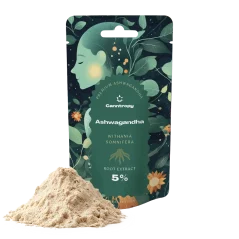
6. What form of ashwagandha is sold at Buds For Buddies?
In the Smartshop, in the herbal supplements section, you will find premium 5% ashwagandha root extract from the Canntropy brand 🌴. This extract is available in several package sizes (5–100 g).
The label "5% extract" means that it contains 5% withanolides, the bioactive compounds responsible for the main benefits of ashwagandha.
Sources:
- health.clevelandclinic.org/what-is-ashwagandha
- ods.od.nih.gov/factsheets/Ashwagandha-HealthProfessional
- pmc.ncbi.nlm.nih.gov/articles/PMC10147008
- pubmed.ncbi.nlm.nih.gov
- onlinelibrary.wiley.com/doi/full/10.1002/hsr2.741
- journalofsportsmedicine.org/full-text/752
Photo: AI
"All information provided on this website, as well as the information provided through this website, is for educational purposes only. None of the information contained herein is intended as a substitute for medical diagnosis and such information is not to be considered medical advice or recommended treatment. This website does not promote, endorse or advocate the legal or illegal use of narcotic drugs or psychotropic substances or the commission of any other illegal activity. Please see our Disclaimer for further information."
Recommended products4
Canntropy Ashwagandha (Withania somnifera) Extract 5%, 5 g - 100 g

Canntropy Kava Kava (Piper methysticum) Root Extract 30% Kavalactones, 5g - 100g
Canntropy Muira Puama (Ptychopetalum olacoides) Extract 10:1 , 5g - 100g